Atlas Periodic Table v0
Do unrelated dynamical systems organize into families based on the geometry of their behavioral landscapes?
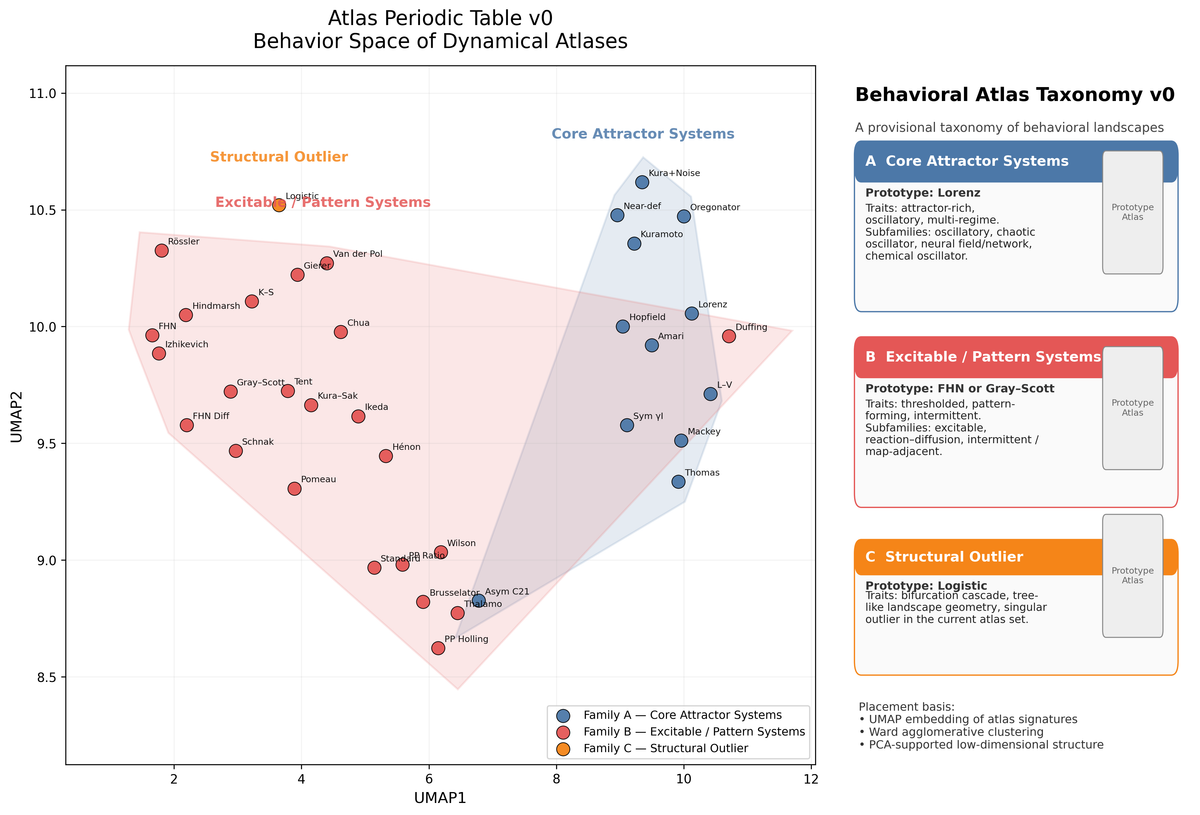
A Provisional Taxonomy of Behavioral Landscapes
Today we reached an important milestone in the Coherence Cartography project.
Using the cross-family atlas analysis pipeline, we embedded behavioral atlases from 36 dynamical systems into a shared behavior space and discovered that they organize into a small number of coherent families.
The resulting map forms what we are calling the Atlas Periodic Table v0 — a first provisional taxonomy of dynamical behavioral landscapes.
The Experiment
Each dynamical system in the library was processed through the atlas pipeline:
- Generate a parameter-space behavioral atlas
- Extract a signature vector describing the landscape
- Compare atlases across systems
- Embed them into a shared space using UMAP
- Identify structural groupings using Ward hierarchical clustering
The goal was simple:
Do unrelated dynamical systems organize into families based on the geometry of their behavioral landscapes?
The Result
They do.
The atlas signatures form a structured manifold rather than a random cloud, and the systems separate into three primary families.
Family A — Core Attractor Systems
This is the largest family and forms the central ridge of behavior space.
These systems share:
- attractor-rich landscapes
- oscillatory dynamics
- multiple behavioral regimes
- structured transitions between regimes
Examples include:
Lorenz
Duffing
Van der Pol
Kuramoto
Hopfield
Amari neural field
Mackey–Glass
Oregonator
Within this family several sub-structures appear, including oscillatory systems, chaotic oscillators, neural field systems, and chemical oscillators.
Family B — Excitable / Pattern Systems
A second family occupies the left wing of behavior space.
These systems are characterized by:
- thresholded or excitable dynamics
- pattern formation
- intermittent behavior
Examples include:
FitzHugh–Nagumo
Hindmarsh–Rose
Izhikevich
Gray–Scott
Schnakenberg
Gierer–Meinhardt
Kuramoto–Sivashinsky
These systems share landscape geometries dominated by large stable regions punctuated by bursts of transition.
Family C — Structural Outlier
One system separates clearly from the others:
Logistic map
Its behavioral atlas reflects a bifurcation cascade geometry rather than basin-type attractor landscapes.
The logistic map therefore forms its own structural class in the current taxonomy.
Transitional Systems
Several systems sit near the boundary between the two primary families.
These include:
Lotka–Volterra
Standard Map
Brusselator
Ikeda
These systems may represent bridge geometries connecting different dynamical mechanisms.
Interpretation
The key insight from this experiment is that dynamical systems organize by the geometry of their behavioral landscapes rather than by the form of their governing equations.
ODEs, PDEs, maps, and neural networks appear in the same families when their behavioral atlases share similar structure.
In other words, the atlas engine appears to be revealing a geometry of dynamical behavior.
Status of the Taxonomy
The Atlas Periodic Table presented here is Version 0.
It should be interpreted as a provisional taxonomy derived from the current atlas library.
Further work will test its robustness under:
- higher atlas resolution
- expanded system libraries
- alternative embeddings
- feature ablation experiments
What Comes Next
Several immediate questions follow from this result.
- Does the taxonomy remain stable as more systems are added?
- Are there additional families yet to appear?
- Can new atlases be automatically placed within the taxonomy?
- Does behavior space contain universal transition pathways between dynamical mechanisms?
These questions define the next phase of the project.
Summary
The Coherence Cartography engine has produced its first taxonomy of behavioral landscapes.
Rather than classifying systems by their equations, we are beginning to classify them by the geometry of the behaviors they can produce.
If the structure seen here continues to hold as the atlas library expands, this approach may eventually produce something like a periodic table of dynamical behavior.