Spectral Instability in Operator Phase Space
Spectral instability in feedback systems manifests as a measurable phase transition in operator space. Under controlled instrumentation, the critical boundary becomes geometrically localizable and reproducible.
Recursion Geometry Lab — Applied Note
Spectral instability in feedback systems manifests as a measurable transition in operator phase space. This note illustrates the transition under controlled instrumentation.
Experimental Configuration
All figures were generated under:
- Q2-v0 instrumentation
- 50×50 phase grid
- Symmetric γI operator family
- Deterministic seed discipline
The phase space is parameterized by (θ₀, θ₁).
At each grid point, we compute operator invariants and derived categorical partitions.
1. Spectral Radius Field
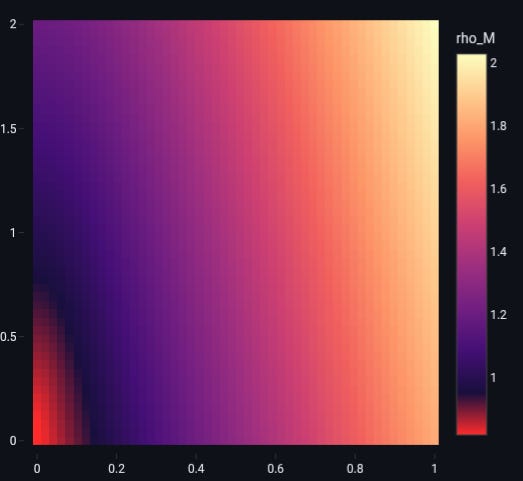
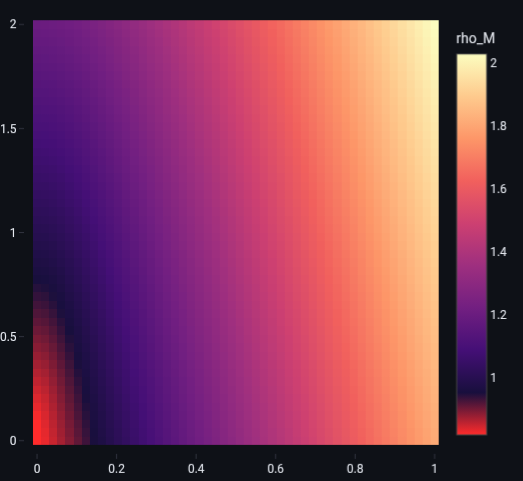
Spectral radius ρ(M) across parameter space.
Q2-v0 | 50×50 grid | symmetric γI family.
The spectral radius varies smoothly across the grid.
The transition toward instability occurs as ρ(M) approaches unity.
This scalar field defines the primary instability driver.
2. Margin Field
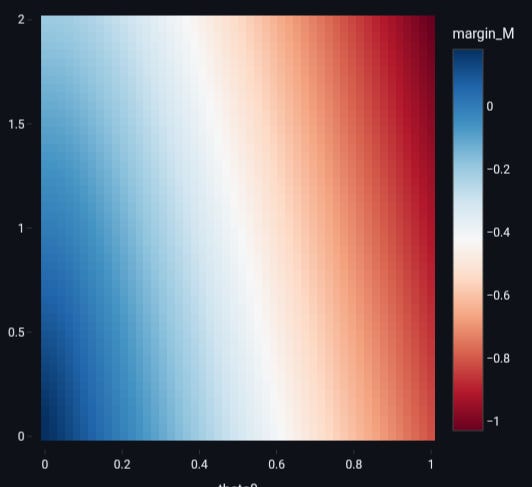
Margin .
The zero contour (m = 0) defines the spectral critical boundary separating subcritical (m > 0) and supercritical (m < 0) regimes.
Q2-v0 | 50×50 grid | symmetric γI family.
The margin provides a signed stability measure.
Rather than inspecting raw spectral radius, the signed margin makes the transition surface explicit.
The critical contour is geometrically well-defined.
3. Categorical Phase Partition (Odot)
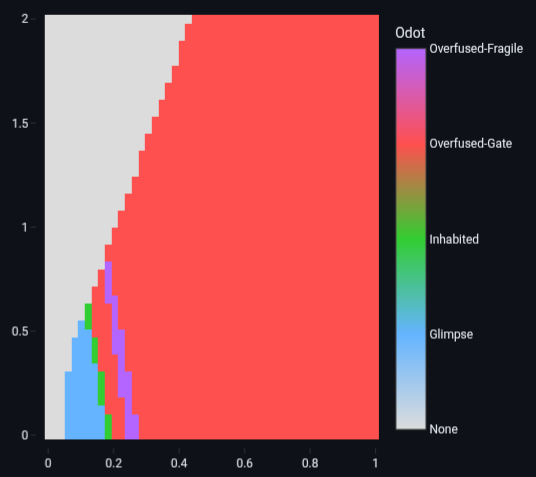
Odot categorical partition induced by operator invariants.
Q2-v0 | 50×50 grid | symmetric γI family.
The categorical layer aligns with the spectral transition.
Distinct regions correspond to structurally different operator regimes.
The phase boundary is not heuristic — it emerges from measurable invariants.
Seam Localization
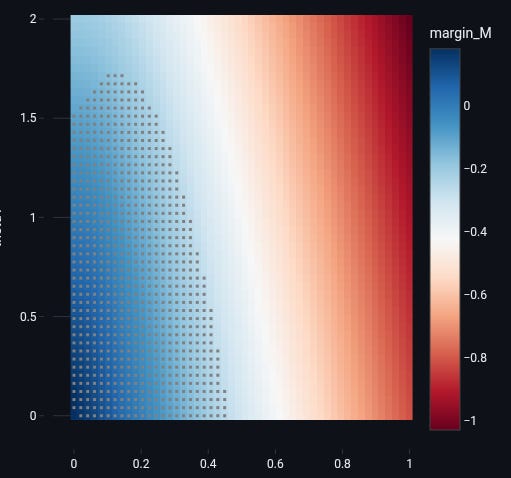
Margin field with seam overlay (soft criterion).
Seam score localizes along the spectral critical contour.
Q2-v0 | 50×50 grid | symmetric γI family
Seam score is defined as the maximal gradient magnitude across scalar fields.
Instability does not distribute uniformly across parameter space.
It concentrates along transition surfaces.
This localization confirms that spectral instability forms a structured boundary in operator space.
Interpretation
This experiment illustrates Class 1: Spectral Instability from the taxonomy.
Failure emerges as spectral radius approaches unity.
The transition surface is:
- Measurable
- Localizable
- Reproducible under fixed instrumentation
Spectral instability is therefore not a qualitative notion, but a geometric feature of operator phase space.
Further posts will examine cross-family separation and reduction effects under Q4 instrumentation.