Structural Separation in Operator Phase Space
Under identical instrumentation, operator families can occupy distinct structural strata. Q4 comparison reveals measurable divergence in signature space and transition boundary overlap.
Recursion Geometry Lab — Applied Note
Under identical instrumentation, operator families can occupy distinct structural strata. Q4 comparison reveals measurable divergence in signature space and transition boundary overlap.
In Post 002 we examined instability within a single operator family.
Here we examine something stronger:
Do different operator families occupy distinct regions of phase space under identical instrumentation?
All atlases compared here satisfy:
- Q2-v0 instrumentation
- 50×50 phase grids
- Identical scalar and categorical layers
- Governance-validated comparability (Q4-v0)
No cross-family comparison is performed unless grid shape, layer definitions, and version constraints match.
1. Q4 Signature Distance
Each atlas is reduced to a structural signature composed of:
- Scalar layer statistics
- Categorical regime proportions
- Seam boundary fractions
Pairwise distances between these signatures yield a separation matrix.
Figure 1 — Q4 Signature Distance Matrix
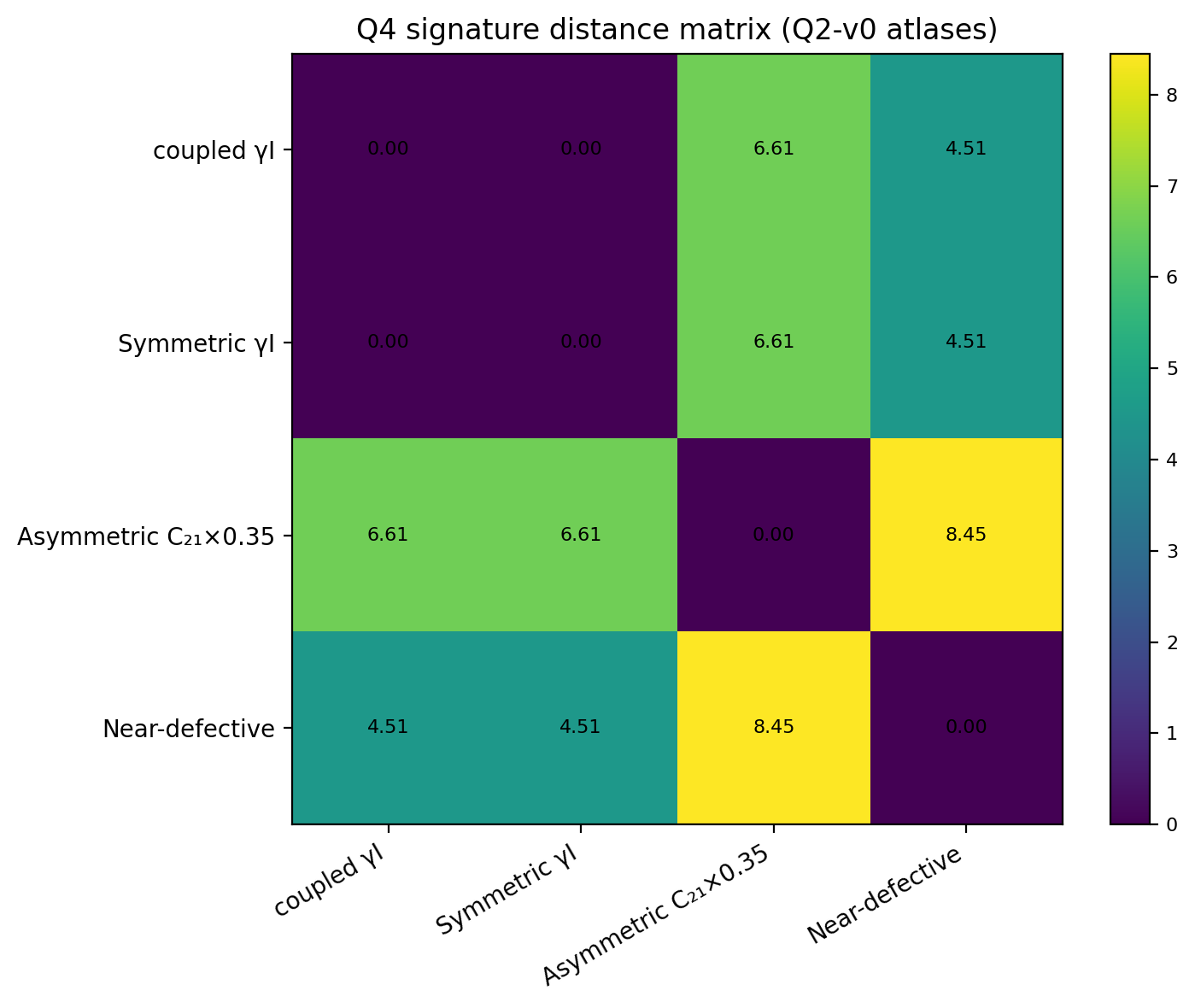
Measured distances:
- Symmetric γI vs Coupled γI: 0.00
- Symmetric γI vs Asymmetric C₂₁×0.35: 6.61
- Symmetric γI vs Near-defective: 4.51
- Asymmetric vs Near-defective: 8.45
Distance equals zero only when structural signatures are identical.
Symmetric and coupled families are indistinguishable under Q2 instrumentation.
Asymmetric and near-defective families occupy distinct structural regions.
This separation is not qualitative — it is measured.
2. Seam Boundary Overlap
Structural separation is not only reflected in global signatures.
It is visible in transition surfaces.
We quantify seam overlap using the Jaccard index.
Figure 2 — Seam Overlap (Jaccard Index)
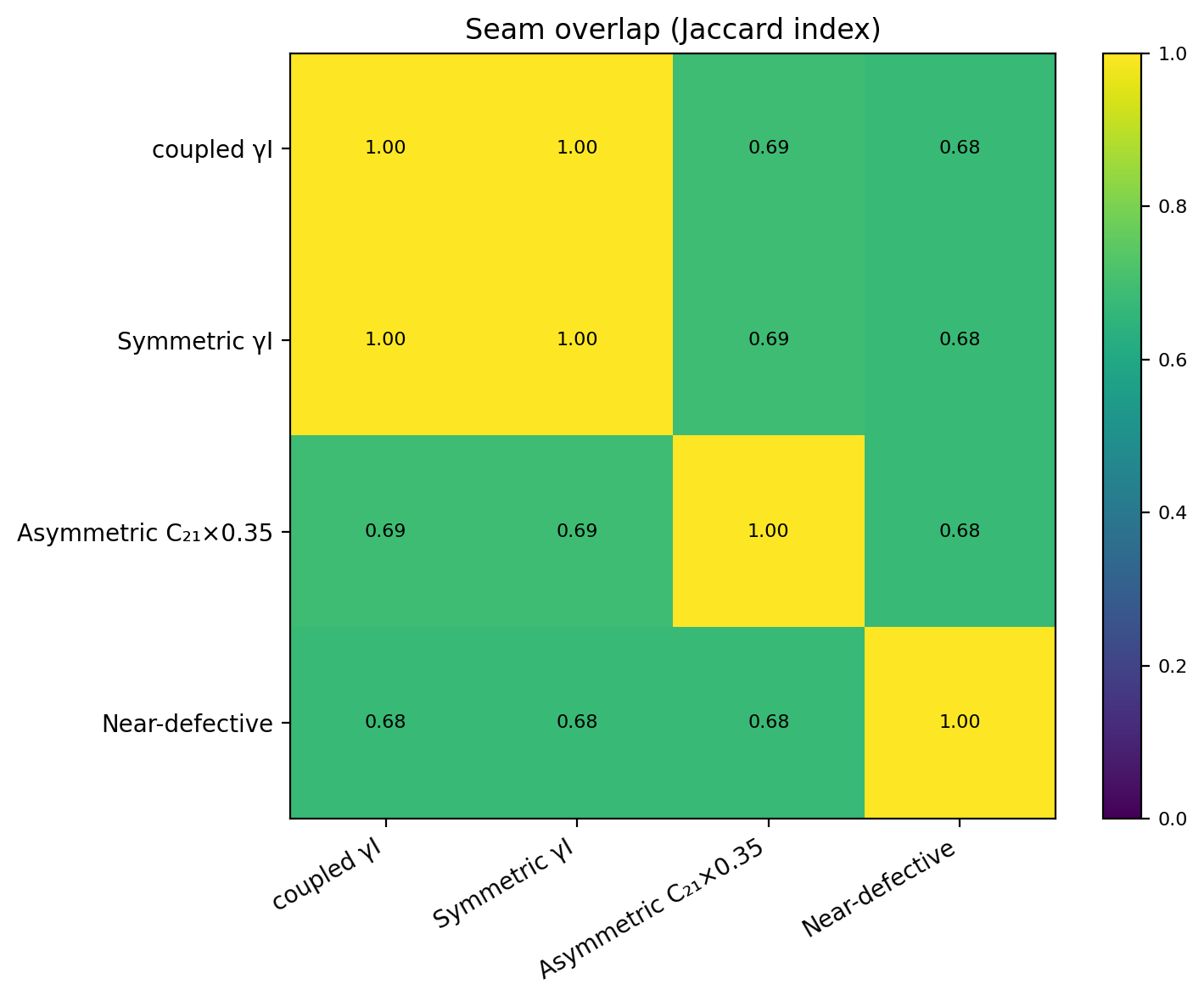
Measured seam overlaps:
- Symmetric vs Coupled: 1.00
- Symmetric vs Asymmetric: 0.69
- Symmetric vs Near-defective: 0.68
Complete overlap indicates identical transition geometry.
Partial overlap indicates boundary shift under structural perturbation.
Operator families therefore differ not only in scalar invariants but also in the localization of instability surfaces.
Interpretation
Under governance-constrained comparison:
- Some operator families are structurally equivalent.
- Others occupy separable regions of operator phase space.
- Transition surfaces shift measurably under perturbation.
This supports a central claim of the Recursion Geometry program:
Operator phase geometry forms structural strata, not a continuous undifferentiated manifold.
Structural separation is:
- Reproducible
- Quantifiable
- Instrumentation-dependent
Further notes will examine reduction behavior and cross-scale invariance.
Next: cross-scale reduction and ΔΩ classification.