The Davey Map: A Minimal Continuous-Time Recursion System
The coexistence of these two structures demonstrates that even minimal recursive systems can exhibit both local stability seams and global transformation corridors. The Davey Map therefore provides a compact model for studying the geometry of dynamical transformation.
One of the goals of the Recursion Geometry Lab has been to understand how systems transform.
Across dozens of dynamical models — reaction–diffusion systems, oscillators, and chaotic attractors — we repeatedly observe the same structural arc:
stable regimes
$\rightarrow$ instability
$\rightarrow$ reorganization
$\rightarrow$ new regimes
Recently we asked a simple question:
What is the smallest dynamical system capable of producing this arc?
The answer appears to be surprisingly small.
A Two-Variable Recursion System
The system we studied is
$\dot{x} = ax - bx^3 + cr$
$\dot{x} = ax - bx^3 + cr$
where
- $x$ represents the current state of the system
- $r$ is a fading trace of past states
The terms correspond to four dynamical forces:
| Term | Interpretation |
|---|---|
| $ax$ | persistence |
| $-bx^3$ | nonlinear containment |
| $cr$ | recursive coupling |
| $-\alpha r + \beta x$ | fading memory |
Despite its simplicity, this system can:
- hold stable equilibria
- generate multiple attractors
- reorganize under parameter changes
We refer to this system as the Davey Map.
Atlas Placement
The Davey Map was added as the 40th family in the Recursion Geometry atlas.
The parameter sweep was
$a \in [-1.5, 1.5]$
$c \in [0, 2]$
with fixed values
$b = 1, \quad \alpha = 0.5, \quad \beta = 0.8$
The system lands in the transformation cell
$\Theta_3 \, \Xi_1$
which corresponds to high persistence with moderate instability.
Interestingly, this is the same structural regime occupied by Chua circuits, a well-known nonlinear electronic system.
An Exact Seam Law
The equilibrium structure of the system can be solved analytically.
At equilibrium,
$0 = ax - x^3 + cr$ $0 = -\alpha r + \beta x$ From the second equation,
$r = \frac{\beta}{\alpha}x$
With the chosen parameters,
$r = \frac{0.8}{0.5}x = 1.6x$
Substituting into the first equation gives
$0 = ax - x^3 + c(1.6x)$
$0 = x(a + 1.6c - x^2)$
The system therefore has three equilibria when
$a + 1.6c > 0$
Rearranging produces a linear transition boundary
$c = -0.625a$
This line represents the analytic seam where non-zero equilibria are born.
In the atlas, this seam corresponds closely to the boundary between stable and divergent regions.
A Second Structure Appears
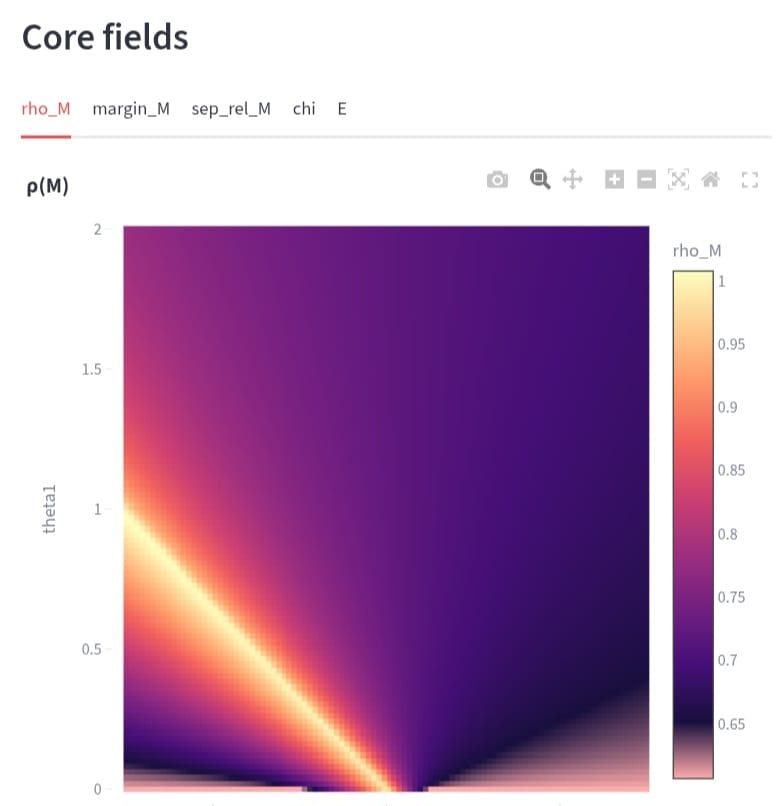
To explore the system beyond local stability, we ran a multi-seed bifurcation scan.
Instead of measuring only the local Jacobian, trajectories were integrated from multiple initial conditions across the parameter plane.
This revealed a second structure: a diagonal ridge of bifurcation activity running through the interior of the stable region.
Fitting this ridge produced
$c = -1.4769a + 2.6833$
with
$R^2 = 0.9903$
This means the transformation corridor is almost perfectly linear.
The ridge marks where
- fixed-point multiplicity changes
- basin structures reorganize
- trajectories diverge toward different attractors
Two Geometries of Transformation
The Davey Map therefore contains two distinct transition structures.
Local seam
$c = -0.625a$
Analytically derived from the Jacobian.
Marks the birth and loss of equilibria.
Global transformation ridge
$c = -1.4769a + 2.6833$
Empirically observed through multi-seed dynamics.
Marks basin-structure reorganization inside the stable region.
These two structures are related but not identical.
The seam governs local stability.
The ridge governs global transformation.
Why This Matters
Most dynamical analyses focus on local bifurcations.
But real systems often transform through global basin competition, not just local eigenvalue crossings.
The Davey Map provides a minimal example where both phenomena appear:
- a mathematically predictable seam
- a separate empirically observable transformation corridor
Even in a system with only two variables, the geometry of transformation is richer than local analysis alone suggests.
A Minimal Transformation Engine
The Davey Map sits at the base of a broader hierarchy of nonlinear systems.
Minimal recursion system
$\dot{x} = ax - bx^3 + cr$
$\dot{r} = -\alpha r + \beta x$ ↓
Physical nonlinear realization
Chua circuit
↓
Chaotic stretch–fold geometry
Hénon map
This suggests that structured transformation manifolds can arise even in very small recursive systems.
Next Steps
Several questions remain open:
- whether similar transformation ridges appear in other $\Theta_3 \Xi_1$ systems
- whether the ridge slope can be predicted analytically from global flow geometry
- how these corridors relate to the Hippasus seam observed across the atlas
These questions will be explored in future Recursion Geometry Lab posts.
Closing
The Davey Map shows that even a minimal recursive system can generate a structured landscape of transformation.
Sometimes the smallest machines reveal the deepest geometry.