Universality Library v0.1 — Seam Morphology Invariants
Seam morphology invariants separate canonical dynamical systems into recurring topology classes. Using motif-based seam typing and component entropy, we show that forced Duffing produces a percolating boundary mesh, while Hénon and Logistic maps exhibit fragmented seam structures.
Abstract
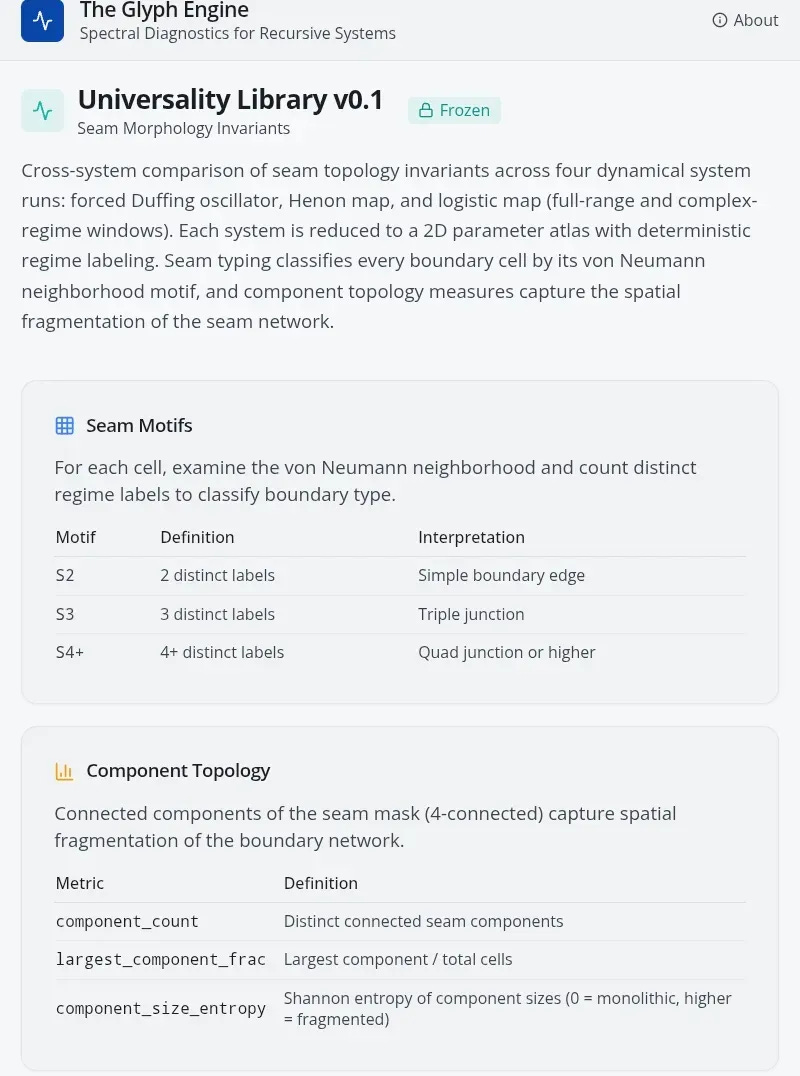
We introduce a minimal universality layer for regime atlases: seam morphology invariants. Using a shared seam-typing module, we classify boundary cells by local neighborhood motifs (S2 simple boundaries, S3 triple junctions, S4+ higher-order junctions) and extract a small topology vector (seam density, junction rates, component fragmentation). Across three canonical system families—forced Duffing (ODE), Hénon map (2D discrete), and Logistic map (1D discrete)—these invariants separate systems into recurring morphology classes under a fixed compute budget.
What we measure
From a categorical regime atlas on a 2D parameter grid, we compute:
- Seam density: fraction of cells on a regime boundary.
- Motif fractions: S2 / S3 / S4+ proportions on seam cells.
- Junction emphasis: aggregate mass of S3+ relative to S2 (junction-rich vs clean-boundary).
- Seam components: connected-component counts and sizes on the seam set.
- Largest component fraction: size of the largest seam component relative to grid.
- Component size entropy: Shannon entropy of the seam component-size distribution (fragmented vs percolating).
These are comparable invariants: they do not depend on the system being continuous or discrete, only on the atlas boundary structure.
Canonical systems included
- Duffing resonance locking (forced ODE; regime labels include mode-locking and chaos proxies).
- Hénon map (discrete 2D; FIXED / PERIOD / CHAOS / DIVERGE).
- Logistic map (discrete 1D; FIXED / PERIOD / CHAOS), including a complex-regime window run to avoid trivial fixed-point dominance.
Key finding
Seam topology separates systems into two morphology families:
- Mesh-class: percolating seam web with nontrivial junction structure (Duffing-like).
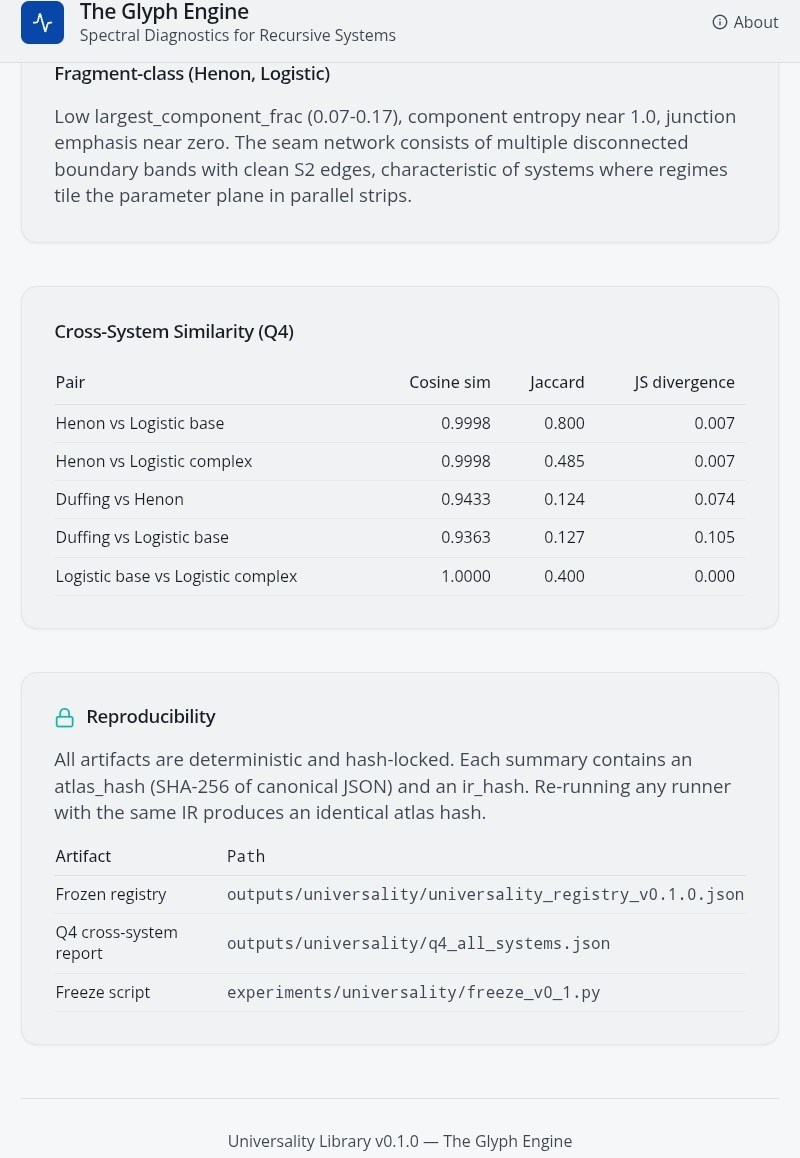
- Fragment-class: sparse seams split into multiple disconnected components with near-zero junction emphasis (Hénon and Logistic-complex-like).
This is the first “universality library” result: seam morphology recurs as a stable invariant class across distinct dynamical families.
Reproducibility artifacts
- Cross-system report:
outputs/universality/q4_all_systems.json - Frozen registry:
outputs/universality/universality_registry_v0.1.0.json
All runs are deterministic with hash-locked summaries.